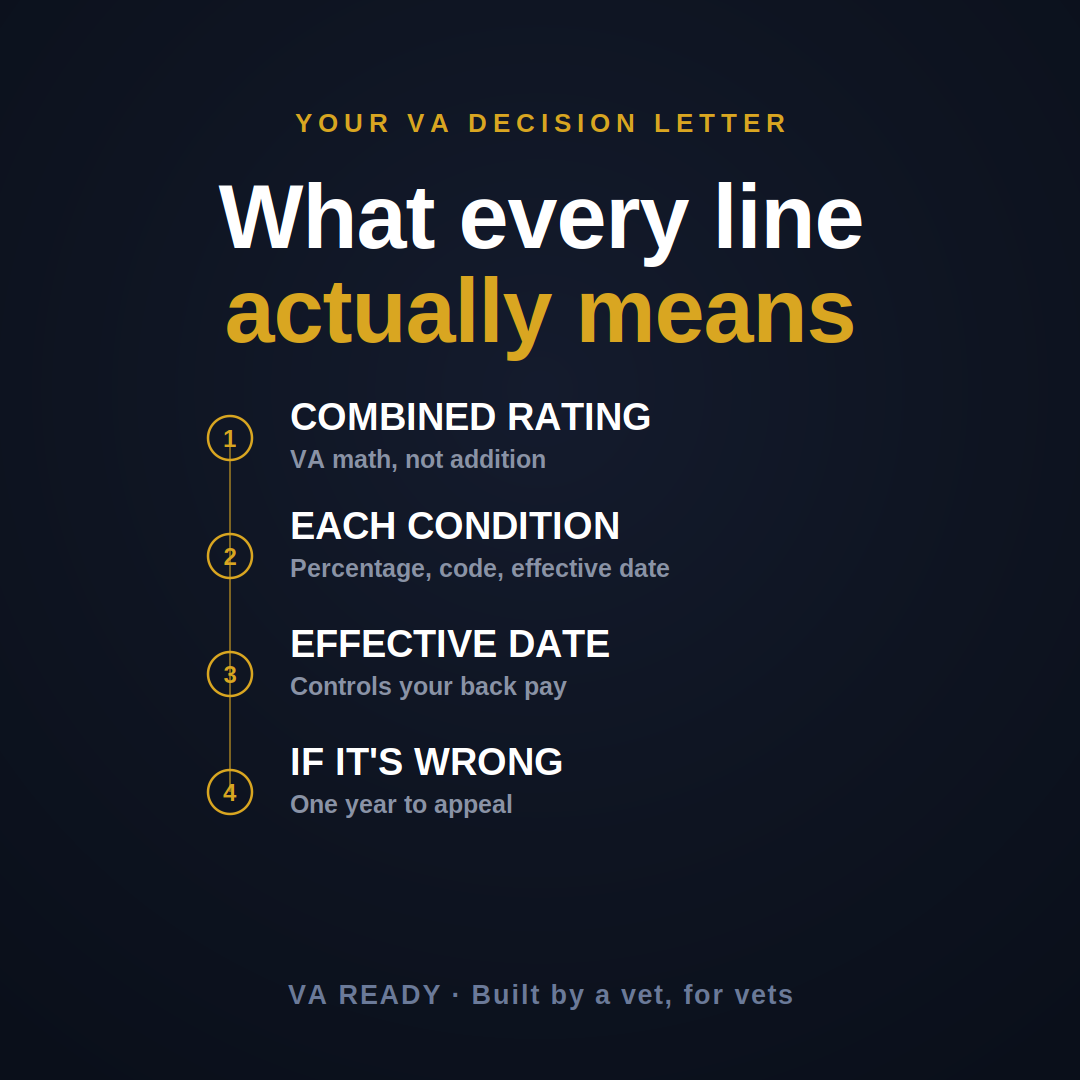
The envelope from the VA finally hits your mailbox, or the notification pops up on VA.gov, and your stomach does a little flip. This is the thing you've been waiting months for. Then you open it and it's a stack of pages full of percentages, diagnostic codes, effective dates, and paragraphs of "reasons and bases" that read like they were written for a lawyer. So let's slow it down and go through it the way you'd want a buddy to explain it. Line by line, plain English, so you know exactly what you got and what to do about it.
What you're actually holding
Your decision usually comes in two parts. There's a notification letter, which is the short version that gives you the bottom line, and there's the Rating Decision, sometimes called the "reasons and bases" or the code sheet, which is the longer document that shows the work. A lot of vets read the first page, see a number, and stop right there. Don't do that. The details that decide how much you actually get paid, and whether it's worth challenging, live in the long part.
Read the whole thing. Then read it again with a highlighter.
The combined rating, and why the math looks broken
Here's the one that trips up almost everybody. The VA does not add your ratings together. If you've got a 50 percent condition and a 30 percent condition, you are not 80 percent. It feels like you should be. That's just not how the regulation works.
The VA uses what people call "VA math," and it's spelled out in 38 CFR 4.25. The idea is that each rating applies to whatever is left of you after the one before it. Start with the 50 percent. In the VA's eyes that leaves you 50 percent "whole." The 30 percent condition then takes 30 percent of that remaining 50, which is 15. Add that 15 back to your original 50 and you land at 65. The VA then rounds to the nearest 10, so your combined rating comes out to 70 percent.
That's why two vets with the exact same conditions on paper can end up at different combined numbers depending on the mix. It isn't a mistake and it isn't the VA shorting you. It's just how the whole-person math shakes out. Your "combined evaluation" is the number your monthly check is based on, so that's the figure to hunt down first.
Reading each condition, one at a time
Under the combined number, the letter breaks out every condition you claimed. For each one, four things matter: whether it was granted or denied, the percentage assigned, the diagnostic code, and the effective date. Take them one at a time.
Granted at a percentage. Good. Now check that the percentage and the diagnostic code actually match the symptoms you live with. The VA rates every condition against a specific list of criteria in the rating schedule. If the number they gave you doesn't line up with the level of impairment you deal with day to day, that's your first flag that something might be off.
Denied. This one stings, but read the reason. It almost always comes down to one of three things: no current diagnosis, no proof of an in-service event or exposure, or no nexus tying the two together. That reason isn't an insult. It's a map. It tells you exactly which piece of evidence is missing, which tells you what to go get.
Deferred. This is the one people misread the most. Deferred does not mean denied. It means the VA needs more time or more evidence on that specific condition before it can decide. Anything that was granted still takes effect now. Watch your mail and VA.gov for a follow-up request on the deferred item, and answer it fast.
The effective date is where your money lives
If you white-knuckle one part of this whole letter, make it the effective date. That single date controls how far back your pay goes, and getting it wrong can quietly cost you thousands in back pay.
The rule is 38 CFR 3.400, and the short version is this. Your effective date is usually the day you filed, or your Intent to File date if you locked one in, or the date your entitlement arose, whichever is later. There's one exception worth real money. If you filed within a year of leaving service, a granted claim can reach all the way back to the day after your discharge. For a lot of vets that's a bigger chunk of back pay than they expect.
So do the math yourself. Look at the effective date on each granted condition and ask whether it lines up with when you actually filed, or when you got out. If the VA used a later date than it should have, that alone can be worth challenging, even if the percentage is fine. An effective date pushed back a few months is real money you already earned.
The part everyone skips: "Reasons for Decision"
This is the section that reads like homework, and it's the most useful part of the whole packet. It lays out which pieces of evidence the VA looked at and which rating criteria it applied to land on your number. Read it closely and you can usually see exactly why you ended up where you did.
Sometimes you'll notice they never mentioned a record you know you sent in. Sometimes you'll catch that they applied the wrong criteria, or measured the wrong thing. Either one hands you a specific, documented reason to push back, instead of a vague feeling that the rating was too low. Specifics are what win a challenge. This section is where you find them.
If it came back low or denied, you have one year
A number lower than you hoped for, or a flat denial, is not the end of the road. It's a fork in it. You have one year from the date on that decision to challenge it, and you've got three lanes to pick from.
A Supplemental Claim is the move when you have new evidence the VA hasn't seen yet, like a nexus letter, a fresh exam, or records you didn't have the first time. You're adding to the pile.
A Higher-Level Review is the move when you don't have new evidence but you believe the VA made a mistake with what you already gave them. A more senior reviewer takes a fresh look at the same file. You can't add new evidence in this lane, but you can ask for an informal conference call to walk the reviewer straight to the error, and taking that call is usually worth it.
A Board Appeal sends your case to a Veterans Law Judge. It's the most thorough option and also the slowest, often a year or more, so most people try a Supplemental or a Higher-Level Review first.
You don't have to pick the right lane on your own. A VA-accredited VSO will read the decision with you and tell you which one fits your situation, for free. Just don't let that one-year clock run out while you sit on it.
A few traps to sidestep
Don't assume "granted" means you're finished. Granted at the wrong percentage, or the wrong effective date, is still worth a second look.
Don't panic at "deferred." It's a pause, not a no.
Don't sign anything that reads like you're accepting the decision if there's any chance you'll appeal. Your one-year window applies either way, and you don't want to sign it away by accident.
And don't toss the packet in a drawer and forget it exists. You'll need it for any appeal, any increase down the road, and any time you add a dependent. Keep the whole thing somewhere safe.
The bottom line
Your decision letter is not a wall of numbers you're stuck accepting. It's a document you can actually read. Find your combined rating and remember it's whole-person math, not addition. Check every condition for the percentage, the code, and the effective date. Read the reasons section to see how they got there. And if the effective date is off or the rating is low, remember you've got a full year and three ways to push back.
If you want a hand walking through it, that's a big part of why we built VA Ready. There's a plain-English guide to reading your decision letter built right in, and the app maps out your next step based on what your letter actually said, from accepting it, to going for an increase later, to picking the appeal lane that fits. The core tools are free, and your information never leaves your device.
You earned this rating. Make sure the letter got it right.
Built by vets, for vets.