Your claim got approved. Congratulations, that is a big deal. Now you are staring at your decision letter trying to figure out one simple thing: when do I actually get paid, and how much?
It is one of the most confusing parts of the whole process, and almost nobody explains it straight. I am going to walk you through it the way I wish somebody had walked me through it, because when my own claim came back, I had no idea how the timing worked and I was confused when the money did not show up when I expected it.
A heads up before we start: every claim is different, and your exact dates depend on your effective date, your decision date, and your situation. Use this to understand how the system works, then confirm your specifics on VA.gov or with your accredited VSO. This is the map, not your personal GPS.
The dates that matter (and they are not the same)
The reason this gets confusing is that people mix up several dates that all sound similar but mean very different things.
Your decision date is the day the VA approved your claim. It feels like the important date, but for payment purposes, it mostly is not.
Your effective date is the date your entitlement to compensation actually begins, and it is the single most important date for your money. In most cases the VA uses the date it received your claim as the effective date. If you filed within one year of leaving active duty, the effective date may be the day after your separation, which can mean a lot of back pay.
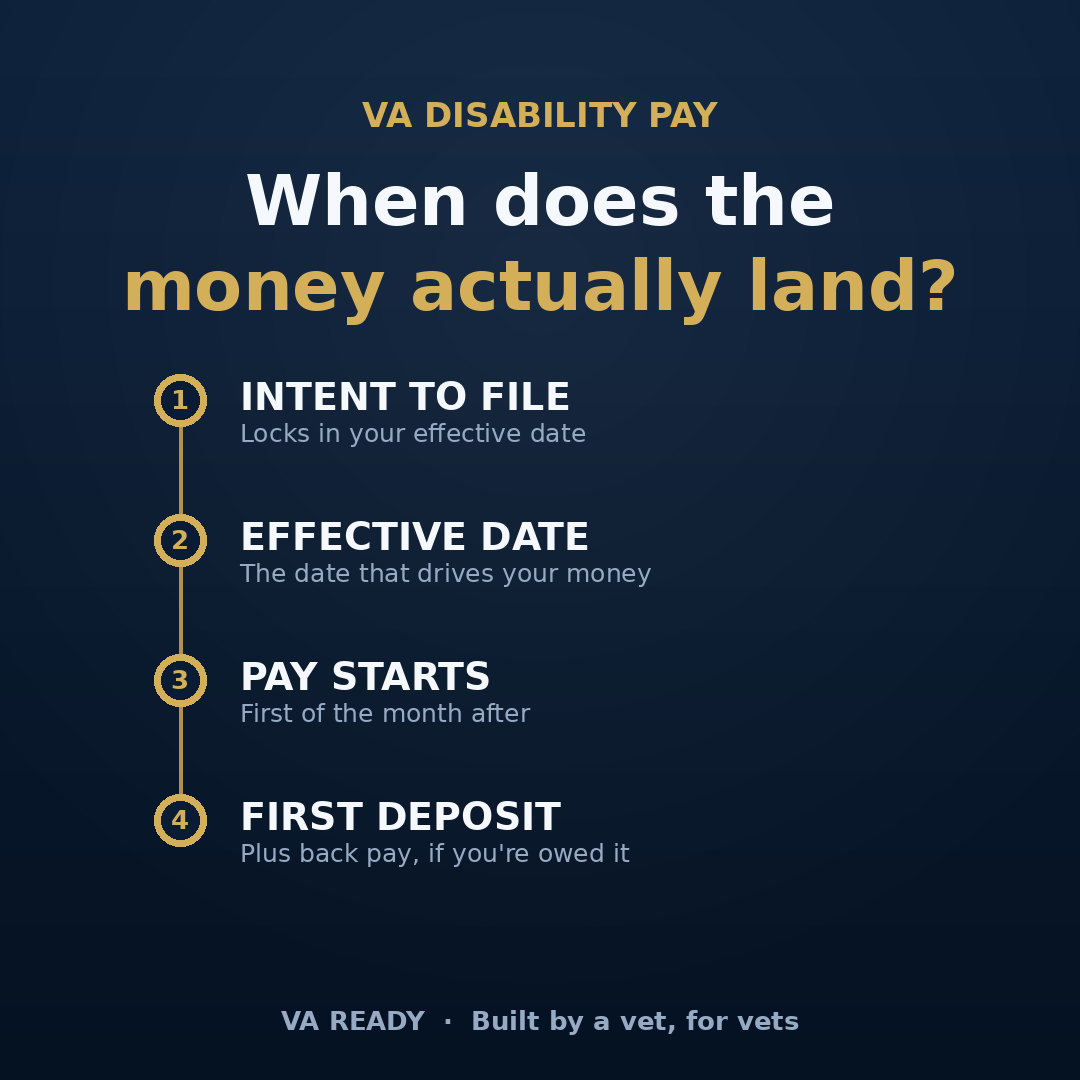
When your pay starts is not the day of your effective date. The VA does not pay for partial months. Payments begin the first day of the month following your effective date.
When the money actually lands depends on processing, but the VA pays monthly going forward, and back pay arrives as a separate lump sum.
Keep those straight and the whole thing starts to make sense.
Intent to File: the move that protects your money before you even file
This is the piece most veterans do not know about, and it can be worth thousands of dollars. Before you file your full claim, you can submit an Intent to File, and it locks in your effective date while you take time to gather everything you need.
Here is how it works. An Intent to File is a simple notice to the VA that you plan to submit a claim. Filing one takes only minutes, but it can protect months of retroactive compensation. Once the VA receives your Intent to File, you have twelve months to gather your evidence and submit your complete claim, and your effective date locks in as the date of the Intent to File, not the later date you actually finish and submit.
Think about what that does. Say you file an Intent to File on June 1, then spend six months gathering medical records and a nexus letter, and submit your full claim on December 1. Your benefits are backdated to June 1, not December 1. Without the Intent to File, that same December 1 claim would have a December 1 effective date, and you would lose six months of pay.
The deadline is firm. If you do not submit your completed claim within one year of your Intent to File, you lose that earlier date, and the VA uses the date it receives your actual claim instead, which can wipe out months of back pay. You cannot extend the year. If you need more time, you have to file a new Intent to File, and your date starts over from the new one.
You can file an Intent to File online at VA.gov, by phone at 800-827-1000, or by mail using VA Form 21-0966. When you start a disability claim online at VA.gov, the system saves your Intent to File automatically when you begin, even if you do not finish right away. Keep your confirmation. That is your proof of effective date.
One important thing to understand: an Intent to File is not the same as a claim. It only protects your date. You still have to file the actual claim within the year for it to mean anything.
How payment timing actually works, step by step
Here is the rule that clears up most of the confusion: VA disability pay is not paid for partial months, and no payment is made for the month in which your claim was received, even if your effective date falls in that month. Your entitlement starts on the first day of the month following your effective date.
Let me use my own situation, because it confused me at the time and it is a clean illustration.
My claim was approved on February 5. My pay start date was March 1. And my first full payment did not hit my account until April 1.
Walk through why:
- My effective date was in early February. The VA does not pay for the month the claim falls in, so February does not pay.
- Entitlement starts the first full month after the effective date, which is March 1.
- The VA issues that going forward, so my first regular monthly deposit landed at the start of April.
Nothing was wrong. That is exactly how the system is designed to work. I just did not understand the timing, so it felt like something was off when it was not.
So where is my back pay?
This is the other big one. A lot of veterans expect a large retroactive lump sum and are surprised when they do not get one. Here is the truth: back pay is not a bonus and it is not automatic in the sense of being large. It depends entirely on how far in the past your effective date sits.
Back pay, also called retroactive pay, is the compensation the VA owes you for the stretch between your effective date and the date they grant your claim. The VA pays it automatically once your claim is approved, usually as a lump sum by direct deposit. The two terms, back pay and retroactive pay, mean the same thing and the VA uses them interchangeably.
Think about what that means for the amount:
- If the VA takes a long time to decide, say a year, your effective date is a year in the past, and they owe you a year of back pay. That is the big lump sum people talk about.
- If your claim is approved quickly, close to your effective date, there is little or no gap, so there is little or no back pay.
In my case, my approval and my effective date were close together. There was barely any retroactive period, so there was barely any back pay. That is not the VA shorting you. It means my claim moved fast, which is a good problem to have. The veterans getting huge back pay checks are usually the ones who waited a very long time for a decision, or who locked in an early effective date through an Intent to File or a within-one-year-of-separation filing.
So if you are looking for a back pay lump sum and not seeing much, check how far apart your effective date and your decision date are. If they are close, that is your answer.
How is back pay calculated?
The VA calculates back pay month by month, using the compensation rate that applied during each month you were owed. Because the VA updates its rates periodically for cost-of-living adjustments, older months in your back pay may be paid at the older rates that were in effect then. Your amount also reflects your combined rating and any dependents, and if your rating changed over the period, the back pay reflects the different tiers across those months.
How soon will I see the money?
Honest answer: it varies, but here is the general shape. After your claim is approved and the award is processed, many veterans see back pay within a few weeks, often within fifteen to thirty days, and it typically arrives before or around the same time as the first regular monthly payment. Watch your bank for a deposit labeled something like VA Benefit or U.S. Treasury 310, and watch your mail for a separate statement breaking down your effective date, the monthly amounts, and the total. Your regular monthly payments then continue on the first of each following month.
If it has been more than a few weeks past your decision and you have seen nothing, that is worth following up on, because something may be held up in processing, like your direct deposit details or a dependency verification. Keep your information current to avoid delays.
The quick version
- Your effective date drives your money, not your decision date.
- An Intent to File locks in your effective date for up to twelve months while you gather evidence. File it early. It is free, fast, and can protect months of back pay.
- The VA does not pay for partial months, and not for the month your claim was received. Pay starts the first of the month after your effective date.
- Back pay is the gap between your effective date and your approval. The bigger the gap, the bigger the back pay. A fast approval close to your effective date means little or none, and that is normal.
- Back pay is calculated month by month at the rates in effect then, and usually arrives as a lump sum within a few weeks of approval.
The bottom line
The day you get approved is exciting, but it is not the day that controls your money. Your effective date does, and the smartest thing you can do to protect that date is file an Intent to File the moment you decide to pursue a claim, even before you have your evidence together.
Find your effective date on your decision letter, count to the first of the next month for when pay starts, and check the gap between your effective and decision dates to know whether back pay is coming.
If your numbers do not seem to add up after you have given it a few weeks, get with your accredited VSO. They can pull your award details and tell you exactly where your payment stands.
You earned this. Now you know when to expect it.