If your claim came back denied for "lack of continuity of symptoms," I want you to hear this first: that's one of the most common denials the VA hands out, and it's one of the most beatable. A denial is not the end of the road. It's the start of the next step. So take a breath, and let's walk through what it actually means and what you do about it.
What that denial actually means
Strip away the bureaucrat language and here's what the VA is really saying: they can see something happened in service, and they can see you have the condition now, but they don't see the thread connecting the two. There's a gap in the middle. The injury or event is in your record, the diagnosis is in your present, and nothing ties them together in a line.
That gap is the whole problem. And here's the thing nobody tells you: a lot of us have that gap on purpose. We were trained to never go to medical. Going on sick call was weakness. Mission first, walk it off, don't be the guy who can't hang. So we never built the paper trail the VA now wants to see. The military culture that kept you quiet in uniform is the same thing creating the hole in your file today. That's not your fault. But it is your job to fix it now, and it can be fixed.
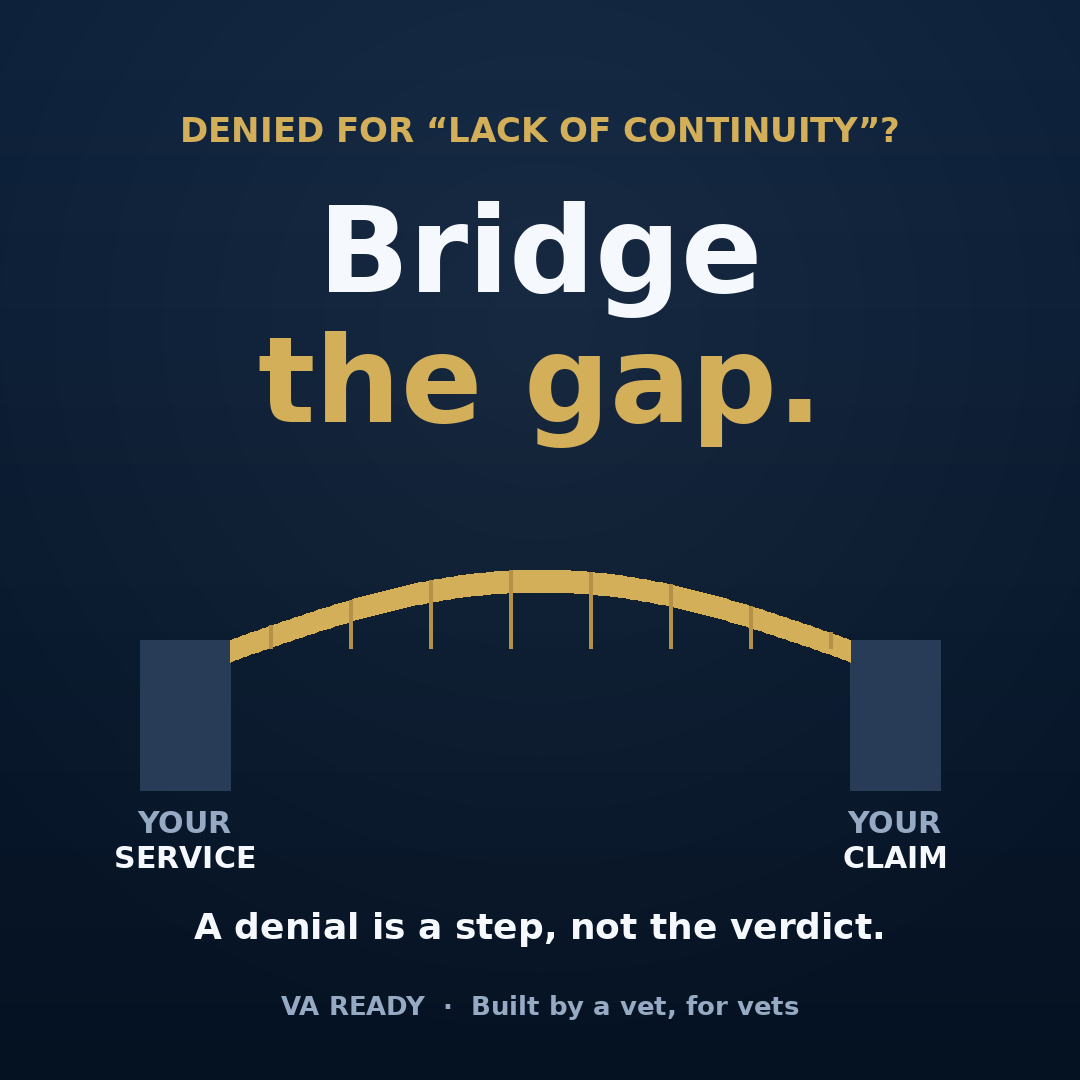
You don't need new injuries. You need to bridge the gap.
This is the part that changes how people think about it. You're usually not trying to prove a brand new injury. You're trying to build the bridge between the service event and the condition you have today. There are a few ways to build that bridge, and you can use more than one at the same time.
The nexus: your bridge
The connection between service and your current condition is called a "nexus." Most of the time it comes down to a medical opinion from a provider, VA or private, stating that your condition is "at least as likely as not" related to your service. That phrase matters. The VA standard isn't "for certain." It's at least as likely as not, which is basically 50/50. You don't have to prove it beyond a doubt. You have to tip it to even.
And if you already got diagnosed at your C&P exam, pay attention, because that's the VA's own doctor putting your condition on paper. That works in your favor. Don't overlook the evidence the VA already created for you.
Buddy statements: the move for guys with no records
If your medical file is thin because you never went to sick call, this is your workaround, and it's a real one. You do not only prove your case with records. You can prove it with statements.
A buddy statement (the VA calls it lay evidence) is a written account from someone who saw what happened or saw you struggle. That can be you, describing the event and how it's affected you since. It can be guys you served with who remember the injury, the blast, the range time, whatever it was. It can be your spouse or family who watched you come home different and deal with it for years. "He stopped sleeping after that deployment." "He's had the ringing in his ears since he ran the range." "His back's been bad since we got out and he never said a word." That counts. That fills the gap the military left in your file.
Lay evidence is legitimate evidence. Use it.
Secondary connections: the conditions that come from other conditions
Some conditions don't connect straight back to service. They connect to another condition that does. Depression and anxiety often flow from PTSD or from living with chronic pain. Stomach issues like IBS frequently tie back to PTSD. If the direct route to service is hard to prove, the secondary route might be wide open. It's worth mapping out which of your conditions might link to each other, not just to service.
Noise exposure is its own paper trail
If you spent real time around weapons, that's an exposure history whether it's written down or not. Range time, combat arms, being a firearms instructor, the gun line, the flight line, the motor pool. That kind of sustained noise exposure is a well understood path for hearing loss and tinnitus. The fact that you lived it is part of your case.
So what do you actually do next?
After a denial, the usual paths are a Supplemental Claim or a Higher-Level Review. The big thing to understand: don't just refile the exact same claim and hope for a different answer. A Supplemental Claim works when you have new and relevant evidence to add, which is exactly what you're building with nexus opinions and buddy statements. Which path fits your situation depends on the specifics, and that's where you bring in help.
Get with an accredited VSO. They are free, that's the law, and they'll sit down and build the strategy with you. And here's where I'll be straight with you, because somebody needs to say it. After a denial, the sharks come out. You'll see ads promising to "maximize your rating" if you just pay them a percentage of your back pay, or a few thousand bucks up front. Some of them aren't even accredited, which means it's against federal law for them to charge you for claims help in the first place. They prey on exactly the moment you're in right now, denied and desperate and willing to try anything. Don't do it. An accredited VSO does the same work for nothing. Your back pay belongs to your family, not to a guy in a call center.
And yes, to answer the question I get all the time: get current diagnoses on the record. VA or private both work. Build the medical record you were never allowed to build in uniform.
A word on evidence, because it matters more than ever
When you build your case, the evidence has to be real. A nexus opinion, a study, a citation, all of it has to hold up when a rater checks it. There's a wave of tools out there now that will generate you a confident sounding claim or spit out a medical citation in seconds. Be careful. If that citation doesn't actually exist, or doesn't say what the tool claims, you won't find out until your claim comes back denied again. The machine sounds sure. The denial letter doesn't care.
When you reference medical research to support a condition, use real, published, peer reviewed studies you can actually point to. Real evidence is the whole game. Made up evidence is worse than no evidence, because it costs you credibility you can't get back.
The bottom line
A "lack of continuity" denial means there's a gap, not that you don't have a case. You bridge the gap with a nexus opinion, with buddy statements, with secondary connections, and with the evidence the VA already put in your file at your C&P. Then you file the right kind of review with that new evidence, with an accredited VSO in your corner.
The denial is a step. It is not the verdict. Build the bridge and keep going.
I built VA Ready because too many good vets get stuck right here and either give up or get fleeced. It maps the real, peer reviewed research to your conditions, helps you organize your claim, and points you to an accredited VSO near you. And it does it without asking you to hand over your life. No account, no login, nothing about your claim leaves your phone. Your conditions, your records, your situation, that's nobody's business but yours. We don't collect it, so we can't sell it or lose it. After everything the VA process already puts you through, the last thing you need is one more outfit harvesting your data. Your claim is yours. We built it that way on purpose.
You earned this. Go get it.
Built by vets, for vets.